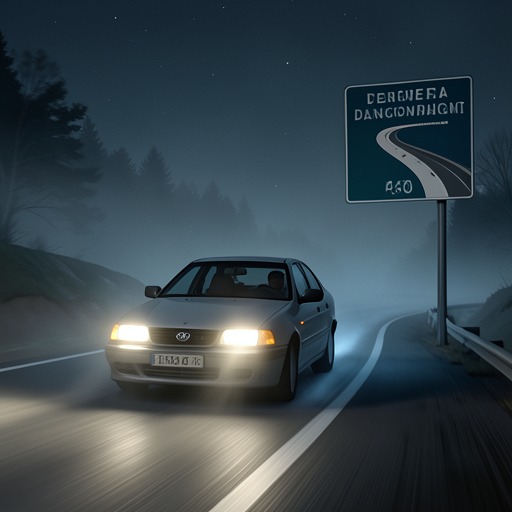
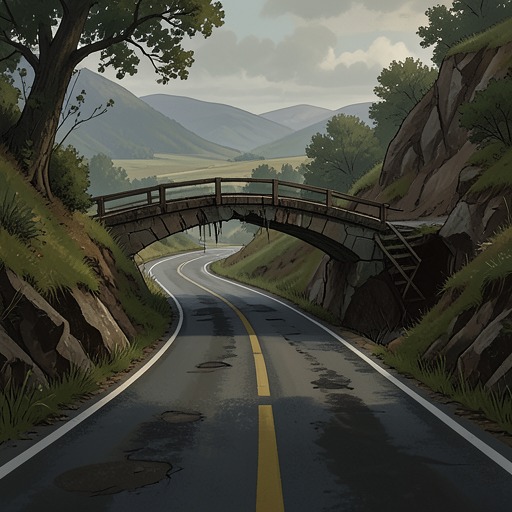
Old Ferry Road's disuse and unsafe condition
Black Water (Joyce Carol Oates Edition)Old Ferry Road's disuse and unsafe condition turn a mistaken turn into a lethal hazard. The road has no sign, is no longer maintained, and should have been officially closed; its rutted approach through the marsh leads toward a dangerous curve and an unmarked bridge. The Senator and Kelly Kelleher take it while hurrying for the ferry, and the car ends up in Indian Creek. The narrative locates the crash not in a blank wilderness but in a failure of ordinary road guidance and upkeep, where the consequences fall on the people traveling through it.
Route and Disuse
Locally known as Old Ferry Road, the route has no sign to identify it; the sign had been absent for years. Its sandy surface is badly rutted, and the road has ceased to be a route people use since a new, paved Ferry Road was built. The old turn lies three-quarters of a mile beyond the turn for the newer road, making it possible to take the wrong route even while traveling in the right general direction.
The road is not simply obscure. Grayling Township no longer maintains it, and the narration states that it should have been officially shut down. The danger thus comes from a route that remains physically accessible despite being disused and unmaintained. The distinction matters: the Senator is not initially lost in the ordinary sense, but the road he has entered no longer serves the traffic pattern he intends to follow.
The Approach to the Crash
The journey takes place under time pressure. The Senator and Kelly leave a party at 17 Derry Road at approximately 7:55 p.m., intending to catch the 8:20 p.m. ferry from Brockden's Landing. They have twenty-five minutes, enough if they drive quickly and take the correct route. Turning onto Old Ferry Road is described as an understandable mistake at dusk, one that does not require alcohol to explain, though the Senator has been drinking and drives quickly.
The turn is abrupt: the Senator brakes and steers sharply, without time to signal, as an angered motorist sounds a horn behind them. The account notes that he takes no heed, not necessarily from deliberate arrogance, but because he simply does not attend to the other driver. As the Toyota continues through the marsh, Kelly notices the increasingly desolate surroundings and worries that they may not make the ferry. The pressure to reach it and the choice of the wrong road converge, but the road's condition and poor legibility supply the immediate setting for the mistake.
Missing Warnings and Physical Hazards
At the apogee of a hairpin curve, the rented Toyota plunges into water neither occupant knew was there. About thirty feet ahead is a narrow wooden bridge with badly weathered planks. There is no warning sign for the bridge, still less for the dangerous curve before it. The road therefore presents a sequence of hazards without the signs that might alert a driver to either one.
The car is estimated to have been traveling at about forty-five miles an hour, based on the skid marks and the extent of damage. The narrative also qualifies the crash's cause: had the car not lost control on the curve, it would very likely have struck the bridge railing before falling into the water, with a similar outcome. That is presented as subsequent speculation, not as a witnessed alternative. The bridge does not make the road safe; it marks another point at which the unmaintained route could have produced a crash.
The Marsh as Setting and Constraint
Old Ferry Road cuts through marshland whose darkness and dense vegetation make the route difficult to read. The narrative identifies the water as Indian Creek, a fast-running stream up to eleven feet deep in some places and twenty feet wide, running northeast toward a tidal pool connected to the Atlantic at Brockden's Landing, about two miles east. What appears to the travelers as an uncharted swamp contains a named, substantial waterway directly beside the road.
The marsh is also a wildlife sanctuary: three hundred acres are preserved as the Grayling Island Wildlife Sanctuary with federal funding. That protected landscape is described through its birds and marsh plants, while Kelly has encountered information about the sanctuary in a tourist flyer at the cottage. The contrast is sharp but not simple: the wetland is protected as habitat, yet the road through it is left without maintenance or adequate warning. In the immediate crisis, mosquitoes, rushes, darkness, and distance from the highway shape the conditions of escape and assistance; the Senator later makes his way back toward the highway on foot and calls Ray Annick.
Significance
The road's role is a chain of conditions rather than a single explanation for the crash. An absent sign and obsolete route make the wrong turn possible; the unmet need for upkeep leaves a rutted road open; the curve, bridge, and water create hazards that are not marked; and the ferry deadline encourages a hurried journey. The account distinguishes these circumstances from the driver's actions, including his speed and drinking, rather than treating the road as the only cause.
That distinction also shapes the aftermath. The Senator tells Ray that Kelly was drunk, became emotional, and grabbed the wheel, and fears that he will be accused of manslaughter. This is the Senator's panicked account over the telephone, not an established finding about the crash. The road's physical dangers are described independently of his attempt to frame responsibility: its disuse and missing warnings are concrete features, while the precise cause of the car's loss of control remains subject to speculation. Old Ferry Road thus stands at the intersection of individual decisions and neglected infrastructure, a route whose apparent availability conceals that it is no longer a safe way to travel.